
The Apache County Most Wanted Program
The Apache County Sheriff's Office posts contact numbers, dispatch details, jail information, and division pages online. It publishes no public most-wanted roster there. That silence says nothing about fugitive work, though. Apache County outstanding warrants exist and get served every year, whatever the website shows. This page links only official programs and republishes no names, photos, mugshots, or lists. An alert can change after an arrest or surrender, so the issuing court has the final word on whether a warrant is active, recalled, quashed, or served. A quash simply means a judge set the warrant aside. Verify any personal concern with the court, not with a shared post.
No Apache County Wanted Roster
Resist the urge to fill the gap with a people-search site, a copied social post, or an old image. None of those is an official Apache County warrant source, and stale announcements often linger online after their terms expire. No office in Apache County, Eagar, Springerville, or St. Johns runs a warrant roundup or amnesty notice. So use the normal route. Call ACSO at (928) 337-4321 or 1-800-352-1850 for law-enforcement routing. If a court case is involved, ask that court directly to confirm the status and what to do next. Sheriff staff can point you the right way. They cannot replace the judge or clerk who keeps the record.
Note: The lack of an online Apache County roster does not prove that a person has no active warrant.
How Apache Most Wanted Lists Work
A most-wanted feature is a chosen public alert, not every unserved warrant in the file. Agencies pick high-priority cases or ones that need public help. Arizona's statewide program describes targets tied to violent offenses, weapons, felony drug matters, and sex-offender-registration violations. That description alone never means a named person is wanted in Apache County. Publication and warrant status run on separate tracks. Someone can hold an active warrant yet appear in no alert at all, while a shared post can lag far behind the court record. The warrant itself changes only through court and service action, such as a recall, a quash, or service after an arrest or extradition review. For the fuller record route, the Apache County active warrants reference lays it out.
Arizona Wanted Task Force Role
The Arizona DPS Arizona Wanted Task Force is the statewide alternative to a county list. It is a multiagency effort joining Arizona DPS, the U.S. Marshals Service, and local partners. The work includes locating fugitives on state or federal warrants and coordinating extradition when someone is found outside Arizona. Those roles explain why a case can cross county and state lines, even with no Apache County roster in sight. The DPS page describes the program itself, which is the right level of detail: an agency effort, not a person's wanted notice.
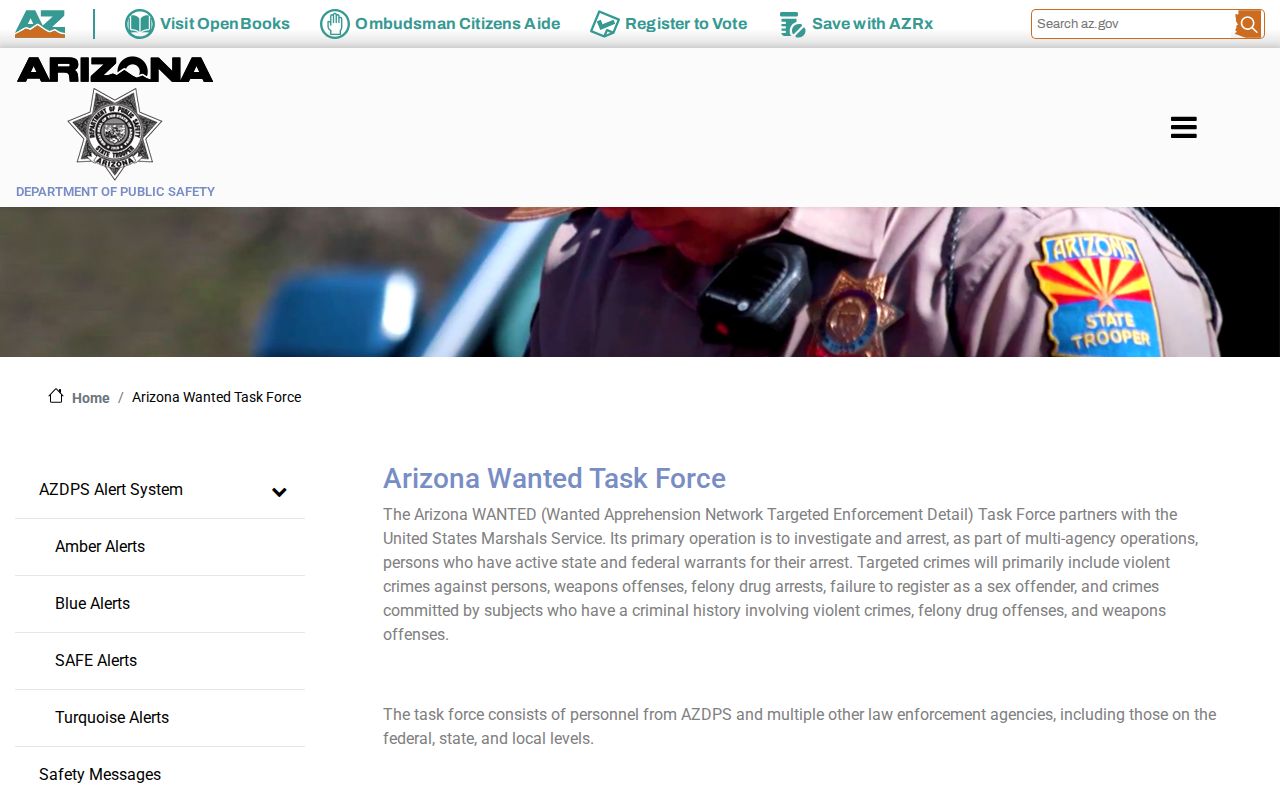
That page belongs to Arizona DPS, not to any Apache County roster. It cannot confirm a warrant.
Report an Apache Wanted Tip Safely
Use an official agency channel whenever you have facts that might help law enforcement. Apache County has no local Crime Stoppers form, reward schedule, or tip app on its official pages, so assume nothing about anonymity or payment. For a local matter, call Sheriff dispatch. For an Arizona DPS matter, follow the contact route the DPS page gives, and ask about its terms.
- Do not approach, follow, restrain, or warn the person.
- Move to a safe place before making the report.
- Give the location, time, direction, and facts you observed.
- Name the official alert that led to the report, if one did.
- Follow the operator’s directions and do not post live details.
Key Point: Apache County posts no verified anonymous tip or reward program, so use an official agency channel and ask about its terms.
Apache County Task Force Links
The U.S. Marshals District of Arizona page describes a federal task-force route. It names a Flagstaff-area contact. It also lists the St. Johns Police Department among partner agencies. That is a real partnership, but read it narrowly. A shared task-force page does not tie any St. Johns resident, Apache County case, or local warrant to federal work. Partner status simply says which agencies can cooperate. It does not turn every local matter into a federal one, and it creates no public Apache County warrant roster. Where a case goes depends on the warrant behind it. Federal matters run through federal court and the Marshals. Apache County sits in the Prescott Division of the U.S. District Court for the District of Arizona, and PACER may show public docket events there, though sealed warrants and restricted documents stay closed.
A municipal case belongs in its town or city court instead. A Superior Court matter goes to the Apache County Clerk of the Court. This split matters. It keeps an alert from being mistaken for a court record, and a task-force contact from being used as a name-search service. Start with whatever agency an official alert names. Marshals notice means the federal route. Arizona DPS means the DPS channel. For a local Apache County question with no clear issuing court, call ACSO dispatch and ask where to route it. The agency speaks to its own alert. Only the issuing court can confirm the warrant.
Apache Most Wanted vs Active Warrants
An active warrant is an unserved court order that a judge has not recalled or quashed. A most-wanted alert is different. In Apache County, as anywhere, it is a public message an agency chooses to put out about a selected case. It may seek leads. It is not a full court inventory of outstanding warrants.
| Feature | Most-Wanted Alert | Active Warrant |
|---|---|---|
| Source | Official agency | Issuing court |
| Scope | Selected cases | Any warrant in force |
| Purpose | Seek information | Authorize legal action |
| Status check | Publishing agency | Issuing court |
| Public absence | Does not rule out a warrant | May exist despite no web result |
Treat an official Apache County alert as a lead. The court answer is what settles warrant status.
Three Apache Public Record Types
Alerts, task-force pages, and court records can look alike because each one may mention a warrant. Their jobs differ. Knowing which source you hold keeps a stale Apache County alert from being read as a live court order.
- Public alert
- An agency notice seeking public help.
- Fugitive task force
- A partnership that locates people sought on qualifying warrants.
- Court record
- The docket or order held by the issuing court.
- Recall or quash
- A judge’s action withdrawing or setting aside a warrant.
Arizona Public Access can help you locate a case. Read its limits, though. The site excludes some records and states its data is not official, current, accurate, or complete, and local ordinance cases may be missing. For those, call the Apache County municipal court involved.
Apache Wanted Program History
A 2021 agreement between Apache County and the U.S. Marshals offers historical context for locating and apprehending fugitives. It documents formal interagency cooperation. It does not prove current staffing, a running campaign, or a live list of any kind. Program papers and present operations are different things. The agreement helps explain why county, state, local, and federal officers may coordinate on a case. It cannot show who is assigned today, which cases remain active, or whether an old alert still stands. The same caution applies to roundups and amnesty events. The Apache County pages, along with the Eagar, Springerville, and St. Johns sites, post no current event notice. That absence is not permanent; any agency may announce an initiative later or use other lawful enforcement methods. If an event does appear, read its date, case scope, place, and deadline on the original agency or court notice. Check which court types and warrant categories qualify. Never carry old terms into a current case. Never assume a general payment option recalls a warrant, either. A clerk can walk you through court procedure. A lawyer can advise whether an appearance, motion, bond, surrender, or another step fits. Final warrant status still comes from the issuing court.
Note: Historical agreements explain cooperation, but they do not confirm today’s Apache County warrant status or program terms.
If You Believe You Are Listed
Do not walk into an agency office on a web result alone. Save the official source first. Note the agency and the court, then contact an attorney. Record the page date and agency name without copying the material into a public post. Counsel can check the issuing court, tell an active warrant apart from an old alert, and discuss a safe voluntary appearance or surrender. A lawyer can also ask about bond and whether a judge requires a motion to recall or quash. For Superior Court records, the Apache County Clerk of the Court is at (928) 337-7550. Justice and municipal files stay with their own clerks. If the venue is unclear, county listings identify the Northstar, Round Valley, and St. Johns Justice Courts, with municipal routes in Eagar, Springerville, and St. Johns. Give the clerk a case number, complaint number, or warrant number when one appears, since similar names alone are not a sound basis for action. Jail questions go to (928) 337-4321 extension 7231. The jail and the issuing court answer different questions: custody and release on one side, warrant status and court procedure on the other. Never send money to a caller or vendor just because someone claims a warrant exists. Ask the court how payment, bond, appearance, recall, or quash works in that exact case, and get official proof of the result.
Important: Contact an attorney and the issuing court before acting. Do not approach a listed person or attempt to handle a warrant yourself.